
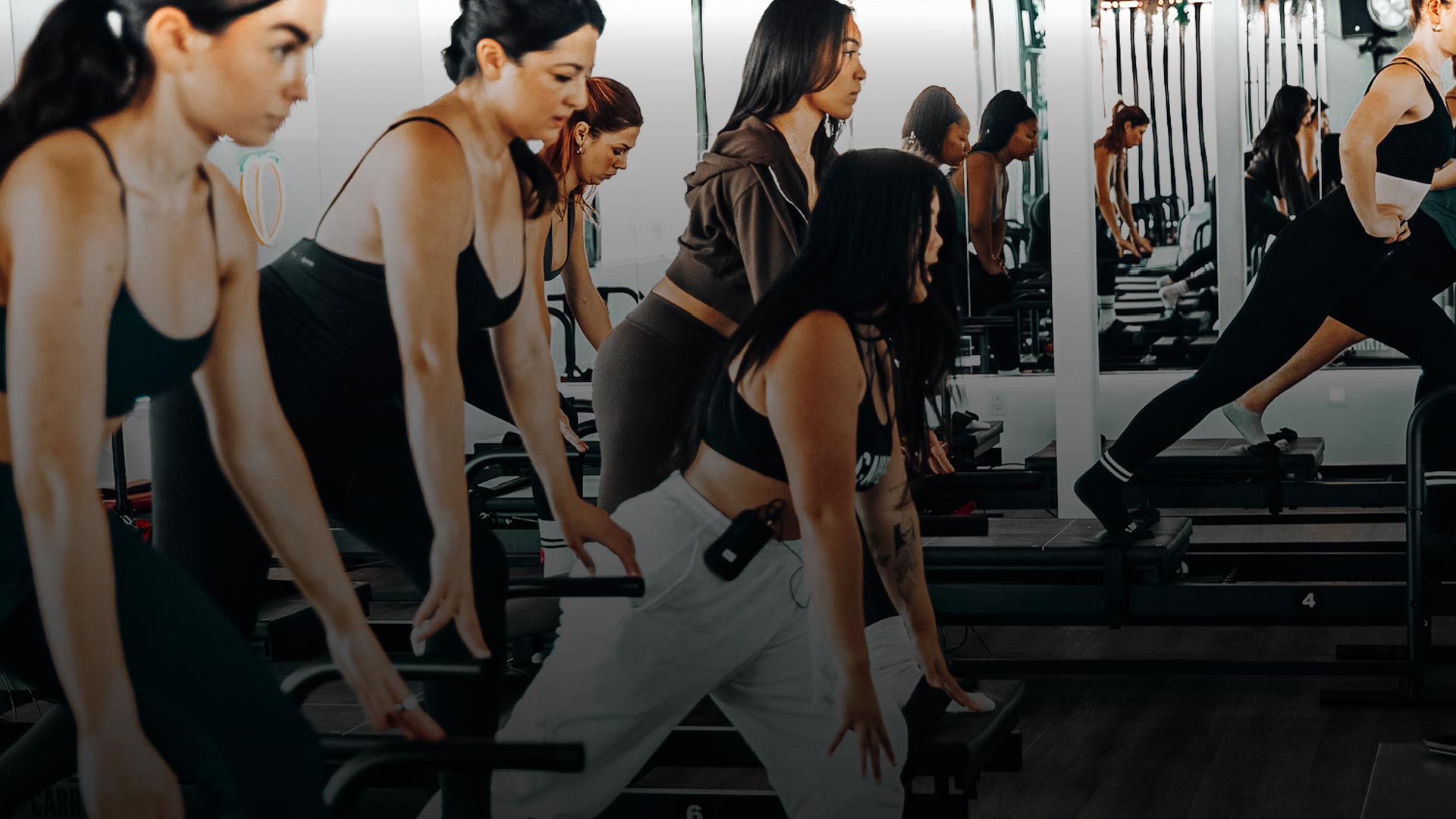
WHY REFORMER PILATES IS SO CHALLENGING (AND HOW TO OVERCOME IT)
Everyone says Reformer Pilates is hard but why, exactly? This guide breaks down the real reasons behind the difficulty, what to expect in your first class, and how to make steady, confident progress.
What Is Reformer Pilates?
Reformer Pilates is a specialized form of Pilates that uses a machine called the Reformer, a spring-based apparatus with a sliding carriage, adjustable resistance, straps, and bars.
Quick answer: Unlike mat Pilates, which uses bodyweight on the floor, the Reformer adds controllable resistance, a wider range of motion, and structural support creating a uniquely effective and uniquely challenging workout.
What the Reformer includes:
| Component | Function |
|---|---|
| Sliding Carriage | Moves along the frame as you push or pull |
| Spring Resistance | Adjustable, lighter or heavier depending on the exercise |
| Foot Bar | Used for footwork, leg press, and standing exercises |
| Straps and Loops | Engage the arms, legs, and core during pulling exercises |
| Shoulder Rests | Support alignment during carriage movement |
The result is a system that works your entire body, strength, flexibility, balance, and coordination in a single session.
Why Is Reformer Pilates So Hard?
Many beginners are surprised by how difficult Reformer Pilates feels even at a light resistance. Here’s why.
1. Constant Resistance and Control
The Reformer’s spring system creates resistance in both directions pushing and pulling. Your muscles never fully rest between movements.
What makes this hard:
- You’re not just supporting body weight, you’re working against spring tension
- The carriage wants to slide; you have to control it
- Resistance can be adjusted, but even lighter springs challenge stabilizing muscles heavily
- Every rep requires sustained muscular effort, not just a momentary push
This is why Reformer Pilates builds functional strength so effectively and why it feels harder than it looks.
2. Deep Core Engagement
Virtually every Reformer exercise demands active core engagement. Not surface-level abs, the deep stabilizing muscles of the trunk, lower back, and pelvis.
Exercises that heavily demand core control:
| Exercise | Core Demand |
|---|---|
| Reformer Bridge | Engages the glutes, hamstrings, and deep lumbar stabilizers |
| Plank on Reformer | Activates the full trunk, shoulders, and hip flexors simultaneously |
| Leg Circles | Requires the pelvis to remain completely still while the legs move |
| Long Stretch | Demands the entire trunk maintain a rigid position on a moving carriage |
Most people’s deep core muscles are undertrained, which is why Reformer Pilates feels so unfamiliar at first, and why it produces such noticeable results over time.
3. Precision and Technique
Pilates doesn’t reward speed. Every movement is slow, deliberate, and technically exacting. There’s nowhere to hide sloppy form.
What precision demands from you:
- Correct alignment of knees, hips, and spine throughout each exercise
- Awareness of which muscles are activating and which aren’t
- Coordinated breathing with every phase of movement
- Sustained concentration for the full session
Popular exercises like The Hundreds, the Mermaid Stretch, and the Pilates Push-Up require all of these elements simultaneously which is why even experienced exercisers find them demanding.
4. Full-Body Engagement
Most gym workouts isolate muscle groups. Reformer Pilates activates multiple systems at once.
Example – the Horse Kick exercise:
- Primary: Glutes and hamstrings
- Secondary: Core stabilizers to keep the pelvis level
- Tertiary: Shoulder and arm muscles to maintain carriage position
- Also: Balance, coordination, and breath control
This full-body demand is why:
- Reformer Pilates burns more energy than it looks like it should
- Fatigue sets in faster than expected
- Results carry over into everyday movement and other sports
5. Increased Range of Motion
The Reformer allows a much deeper range of motion than mat Pilates. This is a benefit but it’s also a significant challenge.
Why increased range of motion is hard:
- Muscles must work through longer movement arcs
- Greater flexibility is required to perform exercises correctly
- Stretching under load (with spring resistance) is more demanding than passive stretching
- Exercises like the Long Spine Massage require deep hamstring and spinal flexibility that many beginners don’t yet have
This is precisely what makes Reformer Pilates so effective at building both strength and flexibility simultaneously but it takes time to develop.
Why Does Pilates Hurt After Your First Few Sessions?
Many beginners ask: why does Pilates hurt so much after my first class?
The answer is simple: Reformer Pilates activates deep stabilizing muscles that most people rarely use in everyday life or standard workouts.
What to expect:
- Mild muscle soreness in the core, inner thighs, and glutes is completely normal
- Soreness typically peaks 24–48 hours after your first session
- It diminishes significantly after 2–3 consistent sessions
- Pain should never be sharp or severe if it is, inform your instructor immediately
The soreness is a sign your body is responding. It fades as your muscles adapt.
Is Mat Pilates Harder Than Reformer Pilates?
This is one of the most common questions beginners ask. The honest answer: it depends on what you mean by “hard.”
| Feature | Mat Pilates | Reformer Pilates |
|---|---|---|
| Resistance | Bodyweight only | Adjustable spring resistance |
| Support | None, your body does everything | Carriage and straps assist alignment |
| Range of Motion | Limited by flexibility | Greater range due to equipment |
| Core Demand | Very high, no equipment support | High, but equipment assists form |
| Beginner-Friendliness | Harder without guidance | Easier to start with instructor support |
| Equipment Needed | Just a mat | Reformer machine required |
Bottom line: Mat Pilates can actually be harder for complete beginners because there’s no equipment to support correct form. The Reformer provides structural guidance but adds resistance complexity.
Reformer Pilates vs. Traditional Gym Workouts
Many clients come from a gym background and wonder how Reformer Pilates compares.
| Feature | Pilates | Traditional Strength Training |
|---|---|---|
| Impact Level | Low, joint-friendly | Medium to high |
| Resistance Type | Spring-based, functional | Free weights, machines |
| Core Focus | Primary in every exercise | Secondary, often isolated |
| Flexibility Training | Integrated throughout | Rarely included |
| Movement Quality | Central focus | Often secondary to load |
| Injury Risk | Lower with proper instruction | Higher without guidance |
| Recovery Time | Shorter | Often longer after heavy sessions |
Reformer Pilates fills the gaps that most gym routines leave particularly core stability, movement quality, and flexibility.
Reformer Pilates vs. Barre
Both formats are popular in boutique fitness, but they’re quite different in approach.
| Feature | Reformer Pilates | Barre |
|---|---|---|
| Equipment | Reformer machine | Ballet barre, light weights |
| Movement Style | Controlled, slow, precise | Isometric holds, small pulses |
| Core Emphasis | Very high | Moderate |
| Flexibility Work | Integrated | Included through ballet-inspired moves |
| Cardio Element | Low | Low to moderate |
| Best For | Strength, mobility, posture | Muscle endurance, toning |
Many clients combine both, using Reformer Pilates for foundational strength and barre for muscular endurance and variety.
How to Overcome the Challenges of Reformer Pilates
Reformer Pilates is challenging but completely manageable with the right approach.
1. Start Slow and Focus on Form
Speed is irrelevant in Pilates. Form is everything.
- Begin with lighter spring resistance
- Focus on understanding each movement before adding difficulty
- Ask your instructor to explain the “why” behind each exercise
- Never sacrifice alignment for more repetitions
A solid foundation in the basics makes every advanced exercise easier later.
2. Work with a Certified Instructor
This is the single most impactful step you can take as a beginner.
What a good instructor provides:
- Real-time form corrections before bad habits form
- Safe modifications for injuries or limitations
- Progression that matches your actual ability not the class average
- Hands-on adjustments that instantly improve movement quality
- Motivation and accountability to keep showing up
Private sessions at the start of your Pilates journey are worth the investment.
3. Be Consistent
Like any skill, Reformer Pilates improves through repetition. The movements that feel impossible in week one feel natural by week six.
Recommended frequency:
| Level | Sessions per Week | What You’ll Notice |
|---|---|---|
| Beginner (Weeks 1–4) | 2 Sessions | Reduced soreness, better form awareness |
| Building (Month 2) | 2–3 Sessions | Visible strength and flexibility gains |
| Progressing (Month 3+) | 3+ Sessions | Stronger core, improved posture, more control |
Don’t judge your progress by how hard it feels. Judge it by how much more control you have than last month.
4. Increase Difficulty Gradually
As your body adapts, increase the challenge progressively not all at once.
Ways to progress safely:
- Increase spring resistance incrementally
- Add new exercise variations as basics become comfortable
- Lengthen session duration gradually
- Move from group classes to private sessions for more targeted work
Progress in Pilates is subtle but consistent. Trust the process.
Most Popular Reformer Pilates Exercises
These are the foundational movements you’ll encounter in most Reformer Pilates classes.
| Exercise | Primary Target | Key Challenge |
|---|---|---|
| Footwork | Legs, glutes, core alignment | Maintaining a neutral spine under resistance |
| The Hundreds | Core, hip flexors, breathing | Coordination of breath and sustained hold |
| Leg Circles | Hip flexibility, core stability | Keeping the pelvis completely still |
| Mermaid Stretch | Side body, obliques, spine | Balance and lateral flexibility |
| Reformer Plank | Full body, shoulders, core | Controlling the carriage while holding a plank |
| Bridge | Glutes, hamstrings, lower back | Achieving hip extension under spring resistance |
| Long Spine Massage | Spinal flexibility, hamstrings | Maintaining a deep range of motion under load |
Ready to Try Reformer Pilates?
Reformer Pilates is challenging because it works and the difficulty is exactly what makes the results so significant.
With the right instruction, a gradual approach, and consistent practice, you’ll move from finding it overwhelming to wondering how you ever trained without it.
Start where you are. Build from there. The Reformer does the rest.
Book Your First Reformer Pilates Session!
FAQs: Reformer Pilates Explained
The Reformer is a Pilates apparatus featuring a sliding carriage, adjustable spring resistance, a foot bar, straps, and shoulder rests. It creates a versatile resistance training system that supports hundreds of different exercises.
Pilates demands simultaneous core engagement, precise technique, controlled breathing, and full-body coordination — in every exercise. There’s no passive rest between movements, which makes it more demanding than it looks.
Yes, overwhelmingly. Most clients report significant improvements in posture, core strength, flexibility, and overall body awareness within a few weeks of consistent practice.
They share some equipment similarities but are different systems. Lagree (pronounced “luh-GREE”) focuses on slow-burn, high-intensity muscular endurance. Pilates emphasizes controlled movement, alignment, and posture. Both are effective, but the philosophy and execution are distinct.
Straps attach to the carriage and are held in your hands or placed around your feet. They create a pulling resistance as the carriage moves — engaging arms, shoulders, hamstrings, and core depending on the exercise.
Most beginners notice improved posture and body awareness within 2–3 weeks. Visible strength and flexibility changes typically appear within 4–6 weeks of consistent practice.
Yes, it’s one of the best options for people with joint sensitivity. The low-impact nature of the workout, combined with adjustable resistance, makes it adaptable for most conditions. Always inform your instructor of any limitations before class.