
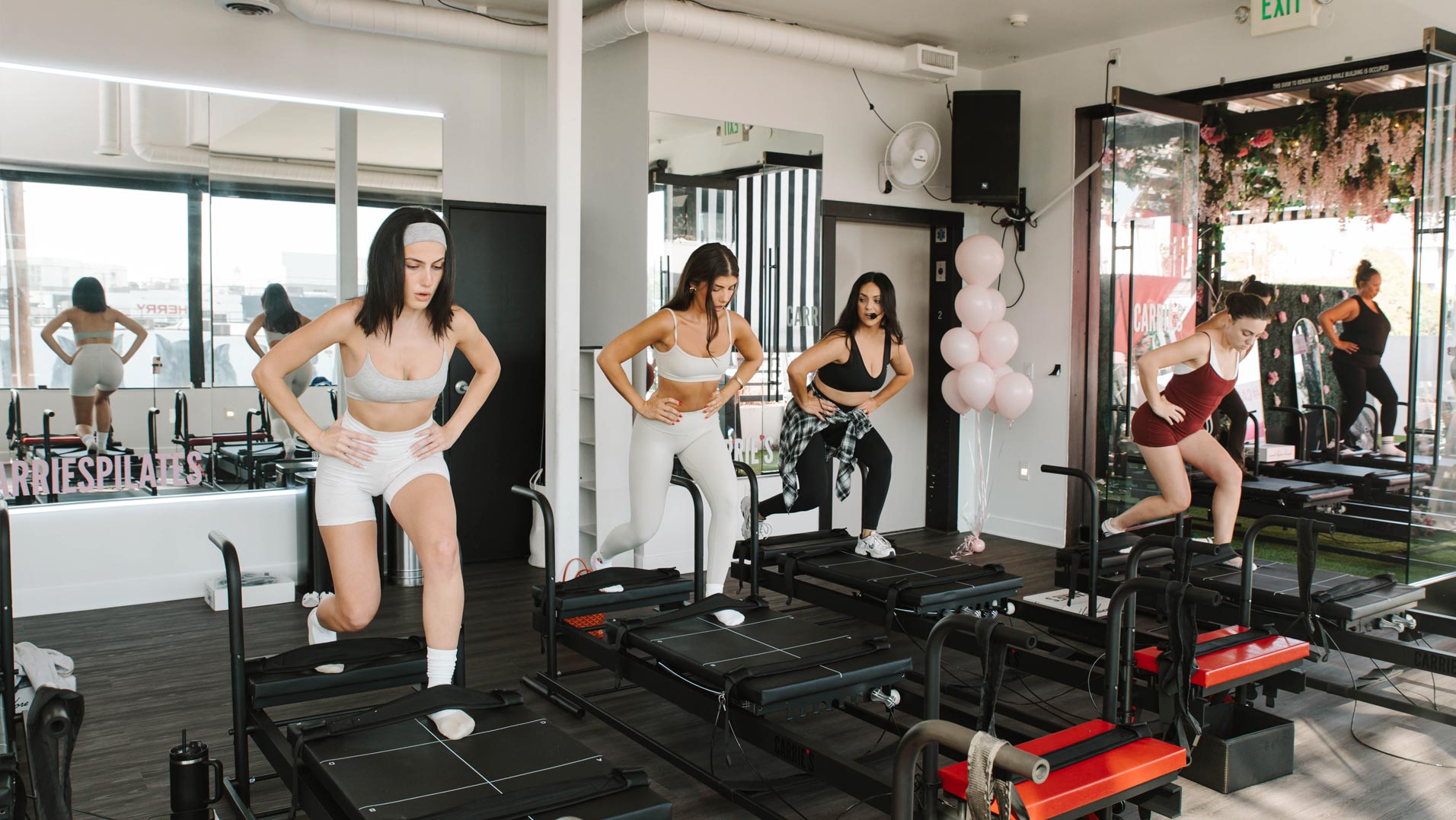
Yes, Pilates can build strength. It uses resistance, controlled movements, and bodyweight exercises to challenge muscles throughout the body. A Pilates workout can target the core, legs, glutes, arms, shoulders, and back while also improving balance, coordination, and mobility.
Unlike traditional weightlifting, Pilates often focuses on how well you control each movement. Muscles work to move against resistance, maintain alignment, and stabilize the body throughout an exercise.
At Carrie’s Pilates West Hollywood, the signature 45-minute Full Body Burn combines Pilates, strength training, and cardio using Carrie’s Transformer. This approach challenges the whole body in one workout.
How Does Pilates Build Strength?
Pilates builds strength by asking muscles to work against resistance while maintaining control and proper body position.
Several training methods contribute to the challenge:
Resistance: Springs, equipment, and bodyweight provide resistance for muscles to work against.
Controlled movements: Slow, deliberate repetitions require muscles to stay engaged throughout an exercise.
Core stability: The trunk helps support the spine and pelvis as the arms and legs move.
Muscular endurance: Repeated movements and sustained holds challenge muscles to keep working.
Balance and coordination: Many exercises require several muscle groups to work together.
The level of difficulty depends on the exercise, resistance, pace, and your current fitness level.
What Muscles Does Pilates Work?
Pilates can target several muscle groups in the same workout. The exact muscles involved depend on the exercise and how it is performed.
Muscle Group | How Pilates Challenges It |
|---|---|
Core and abdominals | Support the trunk and help control movement |
Legs | Push, pull, bend, extend, and stabilize |
Glutes | Support hip movement and lower-body control |
Hips | Help maintain alignment during movement |
Arms | Work against resistance and support body position |
Shoulders | Stabilize the upper body as the arms move |
Back | Support posture and controlled movement |
Feet and ankles | Contribute to balance and lower-body stability |
Many Pilates exercises work more than one area at a time. For example, a leg exercise may also require the core to stabilize the pelvis while the hips and legs move against resistance.
This makes coordination and body awareness important parts of Pilates strength training.
How Does Pilates Resistance Training Work?
Resistance is one of the main ways Pilates challenges muscles.
On a Pilates machine, springs can provide adjustable resistance. Your muscles must control the movement as you push or pull against that resistance. They may also need to control the return to the starting position.
Mat Pilates uses a different approach. Exercises often rely on bodyweight, leverage, and positioning to create a physical challenge.
Both methods can build strength. Equipment simply gives instructors additional ways to adjust the resistance and movement.
How Does Carrie’s Transformer Add Resistance?
At Carrie’s Pilates West Hollywood, classes use Carrie’s Transformer for a range of Pilates-based exercises.
Its adjustable features allow instructors to set up different movements and resistance levels. This gives clients opportunities to work different muscle groups throughout a session.
The signature Full Body Burn combines Pilates, strength training, and cardio in a 45-minute workout. Exercises vary in pace and difficulty, with an emphasis on controlled movement.
Why Is Core Strength So Important in Pilates?
Core strength involves more than the abdominal muscles.
The core helps stabilize the trunk and pelvis while the arms and legs move. It plays a role in maintaining balance, supporting posture, and controlling movement.
During Pilates, your core may need to stay engaged while you push against resistance, change positions, or move one leg at a time.
This is one reason a Pilates exercise can feel challenging even when the movement looks simple.
Core control can also be part of exercises performed while standing, sitting, kneeling, or lying down.
Why Can Slow Pilates Movements Feel So Difficult?
Moving slowly can make an exercise more demanding because your muscles must control the movement instead of relying as much on momentum.
A slow repetition requires attention from beginning to end. You need to maintain your position, move with control, and return to the starting point without losing your form.
This can increase the time your muscles spend working.
At Carrie’s Pilates West Hollywood, the signature Full Body Burn uses very slow movements in many exercises, along with quicker transitions between movements. This combination changes the pace of the workout while keeping control central to the training.
How Does Controlled Movement Improve a Workout?
A controlled repetition involves more than completing the movement.
You need to:
Set up your body in the correct position.
Begin the movement with control.
Maintain alignment as you move.
Resist the movement when returning to the starting position.
Finish the repetition without losing your form.
For beginners, learning these basics helps establish a foundation for future progress.
More experienced clients can also use controlled movement to increase the challenge without relying only on heavier resistance or more repetitions.
Can Pilates Provide a Full-Body Strength Workout?
Yes. A well-designed Pilates workout can challenge the upper body, lower body, core, and stabilizing muscles in one session.
Exercises may include pushing, pulling, bending, extending, holding, and balancing. These movements can work several muscle groups together rather than isolating one area at a time.
A full-body Pilates session may focus on:
Lower-body strength: Exercises that challenge the legs, glutes, and hips.
Upper-body strength: Movements that work the arms, shoulders, and back.
Core endurance: Exercises that require sustained trunk control.
Hip stability: Movements that challenge pelvic alignment.
Shoulder control: Exercises that require stability as the arms move.
Balance and coordination: Movements that combine several actions.
At Carrie’s Pilates West Hollywood, Full Body Burn brings Pilates, strength training, and cardio together. This gives clients a varied workout rather than focusing on one muscle group for the entire session.
Can Pilates Improve Strength and Mobility at the Same Time?
Yes. Many Pilates exercises combine strength with controlled movement through a range of motion.
Mobility refers to your ability to move a joint through its available range. Strength helps you control your body as you move through that range.
For example, an exercise may require you to move your hips while keeping your pelvis stable. Your body needs enough movement to complete the exercise and enough muscular control to maintain proper form.
Pilates can include both elements in the same session.
The specific benefits depend on the exercises performed, your starting point, and how consistently you train.
Is Low-Impact Pilates Still a Challenging Workout?
Yes. Low impact describes the amount of impact involved in a movement, not how hard your muscles must work.
Many Pilates exercises do not rely on repeated jumping or hard landings. They can still challenge the body through resistance, sustained holds, controlled repetitions, and changes in position.
Here is how different Pilates methods can support common fitness goals.
Fitness Goal | How Pilates Can Help |
|---|---|
Strength | Uses resistance and repeated movements |
Core endurance | Challenges trunk stability over time |
Mobility | Encourages controlled movement through a range of motion |
Balance | Requires stable positioning during movement |
Coordination | Combines different movements within one exercise |
Conditioning | Uses continuous exercise sequences and changes in pace |
Pilates can be a useful option for adults who prefer lower-impact exercise. However, the workout should still match your current fitness level and physical needs.
If you have an injury, ongoing pain, or other physical limitations, talk with a qualified healthcare professional or instructor about appropriate modifications.
Is Pilates Strength Training Suitable for Beginners?
Yes. You do not need advanced strength or flexibility to begin Pilates.
Beginners can start with basic movements and learn how to use the equipment before progressing to more demanding exercises.
At Carrie’s Pilates West Hollywood, new clients receive guidance on using Carrie’s Transformer, learning proper technique, and modifying exercises when needed.
If you are attending your first class, consider these tips:
Arrive early so you have time for an introduction.
Tell your instructor that you are new to Pilates.
Ask questions if you are unsure how to perform a movement.
Focus on technique before trying to increase the difficulty.
Use modifications when an exercise feels too challenging.
Let your instructor know about relevant injuries or physical limitations.
You do not need to keep up with more experienced clients. Learning to move with control is an important first step.
How Do You Measure Progress With Pilates?
Progress does not always mean using more resistance or completing more repetitions.
You may notice improvements in your ability to:
Maintain balance during an exercise.
Control the movement from beginning to end.
Keep proper form for more repetitions.
Coordinate your arms, legs, and core.
Move through a comfortable range of motion.
Complete exercises with greater confidence.
As your technique improves, an instructor may adjust the resistance, exercise setup, pace, or number of repetitions.
Strength gains depend on several factors, including the level of resistance, training frequency, recovery, nutrition, and your starting fitness level. Consistent training and appropriate progression can help you continue to challenge your muscles.
How Often Should You Do Pilates for Strength?
Your ideal schedule depends on your fitness goals, experience, recovery, and other exercise you do.
Some people use Pilates as their main form of exercise. Others combine it with weight training, walking, running, or other cardio activities.
When building a routine, consider the following:
Start with a realistic schedule. Choose a frequency you can maintain.
Allow time for recovery. Your muscles need time to recover between demanding workouts.
Focus on technique. Good form helps you perform exercises with better control.
Progress gradually. Increase the challenge as your strength and experience improve.
Consider your overall routine. Include a balance of strength, cardio, mobility, and recovery based on your goals.
You do not need to make every workout extremely difficult. A consistent routine that fits your needs is a more practical approach to long-term fitness.
Try Strength-Focused Pilates at Carrie’s Pilates West Hollywood
If you want a workout that combines Pilates, strength training, and cardio, Carrie’s Pilates West Hollywood offers its signature 45-minute Full Body Burn.
The workout uses Carrie’s Transformer and includes controlled movements designed to challenge different areas of the body.
Carrie’s Pilates follows a More Than Pilates approach that brings together Pilates, cardio, strength training, experienced instructors, and community.
Whether you are new to Pilates or looking to add variety to your fitness routine, an instructor can help you understand the movements and find appropriate modifications.
Explore classes and current introductory offers at Carrie’s Pilates West Hollywood to find an option that fits your fitness goals.
Frequently Asked Questions About Pilates and Strength
Can Pilates really build muscle strength?
Yes. Pilates can challenge muscles through resistance, bodyweight exercises, controlled repetitions, and sustained holds. The results depend on the exercises, training frequency, resistance, and individual fitness level.
Is Pilates a low-impact workout?
Many Pilates workouts are low impact because they do not rely on repeated jumping or hard landings. However, low impact does not mean easy. Resistance and controlled movements can still make a workout physically demanding.
Which muscles does a Pilates workout target?
Pilates can target the core, abdominals, legs, glutes, hips, arms, shoulders, and back. Many exercises also challenge the muscles that help maintain balance and stable body positioning.
Can beginners use Pilates for strength training?
Yes. Beginners can start with basic exercises and learn proper technique before increasing resistance or difficulty. Instructors can offer modifications based on experience and ability.
Is Pilates as effective as weightlifting for building strength?
It depends on the type of strength you want to develop and how you train. Pilates can build strength through resistance, bodyweight movements, and controlled repetitions. Traditional weightlifting often allows more direct progression to heavier loads, which can be important for maximizing muscle size and strength. The two methods can also complement each other.
Can Pilates help build core strength?
Yes. Many Pilates exercises challenge the muscles that stabilize the trunk and pelvis. Core work often happens alongside arm and leg movements rather than through abdominal exercises alone.
How long does it take to get stronger with Pilates?
There is no single timeline for everyone. Progress depends on your starting fitness level, exercise selection, training frequency, recovery, and how the workout becomes more challenging over time. Consistency and good technique are important.
Where can I take strength-focused Pilates classes in West Hollywood?
Carrie’s Pilates West Hollywood offers a signature 45-minute Full Body Burn that combines Pilates, strength training, and cardio using Carrie’s Transformer. Check the studio’s current class schedule and introductory offers for details.